This blog is a part of the eTwinning project between Sääksjärvi primary school in Finland and Rosso di San Secondo middle school in Italy. Our project consists of different tasks: some (like emailing and chatting) are done in TwinSpace while others (presentations on our schools and areas) are shown here. This project will be a good chance for all of us to learn to work together and to build positive relationships which may help us grow as European citizens.
Palermo
is Sicily's cultural, economic and tourist capital.
Palermo
is located in the north west of Sicily, right by the Gulf of
Palermo in the Tyrrhenian Sea.
It’s
a big city with a population of about 860,000 people, while its
metropolitan area is the fifth most populated in Italy with around
1.2 million people.
Palermo
has a very ancient history. It was founded by the Phoenicians in
734 BC.
Because of its position, many different people ruled Palermo during the ages.
It
was ruled by the Greeks, the Carthaginians, the Romans, the Goths
and the Byzantines.
Later
the Arabs captured Palermo, and it became the capital of the
Independent Emirate of Sicily.
In
1072 the Normans took over Palermo and it became the capital
of a new kingdom (from 1130 to 1816), the Kingdom of Sicily.
Then
English, Spanish, French and Germanic kings ruled Palermo.
All
these people left great traces of their rule on the culture,
architecture and historical sites of this extraordinary city.
Tourists love Palermo because of its pleasant
Mediterranean weather (in winter the temperature is about 15° C
and in summer the temperature is about 32° C), its Arab,
Byzantine, Norman ,Romanesque and Baroque churches and historical
buildings and its delicious food.
Welcome to Palermo, the biggest city in Sicily and one of the largest in
Italy!
Class
3 E’s trip to Palermo
On
May 10th
we Class 3 E from “Rosso di San Secondo” in Caltanissetta, took a
coach, together with three teachers, to go to Palermo. This trip was
part of our eTwinning Project with Sääksjärvi Primary school in Mäntsälä,
Finland.
Come
with us! We’ll be your guides: we’ll tell you the history of this
ancient and magnificent city and show you some of Palermo’s most
important buildings.
1. Here
we are on the coach and we’re going to Palermo
3.
The
Norman Palace (Palazzo
dei Normanni) is located in the heart of the original town. In the 9th
century the Arab emirs built this majestic building. Later the Normans transformed it into luxurious palace. There is a spectacular Palatine Chapel inside, which was also built
by the Normans. The Norman Palace has been the seat of the
Regional Sicilian Assembly since 1947.
The Royal Palatine Chapel (Cappella
Palatina) is the royal chapel of the Norman kings of Sicily and it is situated at the centre of the Royal Palace in Palermo. The chapel was built by Roger II of Sicily in 1132. It contains mosaics works and fine art.
Class 3 E in front of the Royal Palace CLICK 4
Orleans PalaceThis
is the house and garden in which Louis Philippe d’Orléans, the
future king of France, lived in exile from 1810 to 1814. Today, it is
used by the Sicilian Regional authorities. CLICK
5 New Gate(Porta
Nuova ) was built
under Charles V, the Porta New Gate is still the main
entrance to the city centre from the west. This magnificent
gateway was built in 1535 and renewed in 1681 after being struck by a
lightening. It was built to celebrate King Charles V victory at Tunis
in Africa. CLICK
6
The Cathedral–
Palermo’s Cathedral is an imposing
building.
It was built in the late 12th
century in the Sicilian Norman style, but
ithas
undergone considerable alteration over the centuries.Inside,
there are the tombs of members of the Swabian royal family: Frederick
II, his wife Constanza of Aragon, Henry IV and Roger II . 3E in front of the Cathedral The entrance to the Cathedral CLICK
7 Praetorian Square:The Fountain and Praetorian PalaceAt
the centre of this lovely piazza is a spectacular fountain, which was built in
the 1500s. There are centric circles with statues of gods
and goddesses, nymphs, monsters, animals’ heads, allegories,
ornamental staircases and balustrades. This fountain is a kind of
Mount Olympus. In the square we can also see Palazzo
Pretorio.
Probably it dates from the 1300s. Since then, it has been the seat of
the City Council .
8
San Cataldo ‘s Church is a typical example of the Arabian - Norman architecture, which is unique to Sicily. It has a rectangular plan
with blind arches. The ceiling has three characteristics red, bulge
domes and Arab-style merlons which give the place an exotic feel. CLICK
9 .St.Mary
of the Admiral (or “The Martorana”). This church was founded in 1143. The linearity of the Norman original is
unfortunately concealed behind the Baroque façade. Mass is
celebrated according to the Greek Orthodox dogma in this church. CLICK
10
Bellini’s Square–
This small square has three churches: Santa
Caterina, La
Martorana
and San
Cataldo with its three red domes gives the place an eastern feel. CLICK
11
The Massimo Theatre (Teatro
Massimo
) This opera-house is the biggest in Italy, and one of the largest of
Europe and it is well known for its perfect acoustics. It was completed in 1897.
The auditorium was planned for 3,000 people, but today it can host
about 1500 spectators.
12
The Politeama Theatre
– The Politeama
Theatre
is as imposing and built in the same Neo-Classical style as the
Teatro Massimo. Its façade is dominated by a quadriga with bronze
horses.
It was built in 1891.There are 5000 seats in it.
13
Palermo’s Port. The harbor has an important part in the history of Palermo . The name
Palermo comes from the Greek Panormus
which
means “all port”. Today it is one of the biggest ports in Italy . CLICK Palermo harbour
One April morning we (class 6) and two of our teachers took the train from Mäntsälä to Helsinki. This trip was a part of our return ticket project with Rosso di San Secondo school in Italy. We saw and visited many famous sights in the centre of Helsinki and took lots of pictures (over a thousand!) as well as some video clips. So, this was Helsinki on a spring day, sunny but a bit cold :) Here we are on the train. The train journey from Mäntsälä (Sääksjärvi primary school is situated in Mäntsälä) took 40 minutes.
Helsinki - fast facts
Helsinki is the capital and largest city in Finland.
The population of Helsinki is over 600.000, but over 1.000.000 people live in the Helsinki metropolitan area.
Helsinki is situated on the south coast by the Baltic Sea and there are over 300 islands around Helsinki.
Helsinki is the northern most capital in EU.
Helsinki is Finland's major political, educational, financial, cultural and research centre
King Kustaa Vaasa set up Helsinki in 1550 (Finland was a part of Sweden then).
Helsinki is one of the coldest cities in the world. The average annual temperature is + 5 degrees (we would like it to be a bit warmer :). In winter the temperature can be as cold as -30 degrees below zero while in summer time we can enjoy +30 degrees in the sun!
Helsinki was the World Design capital in 2012.
all photos and videos by class 6
Helsinki central railway station
Helsinki Central railway station is a landmark in central in Helsinki.Over 200.000 people use it every day. It is Finland's most-visited building.
The Helsinki Cathedral (evangelic Lutheran church)
One of the most famous sights in Helsinki. For many it is the symbol of Helsinki.
The church has a tall green dome surrounded by four smaller domes. The building represents neoclassical style. White church and blue sky - the colours of Finland's flag. Beautiful!
Class 6 sitting on the steps of Helsinki Cathedral.
The Senate Square
The Senate Square is the very centre of Helsinki. It is surrounded by a number of significant buildings, such as the Helsinki Cathedral, the Government Palace and the main building of University of Helsinki. In the middle of the square you can see the statue of czar Alexander II of Russia.
The main building of University of Helsinki
The Esplanade Park
In the heart of Helsinki there are two famous streets: North Esplanade and South Esplanade. There is a lovely walking path between them.
Around the Market Square
The statue of Havis Amanda. Every year on the eve of 1st of May (Vappu), this statue is a centre for celebrations. Students of the local universities put a cap on the statue in an elaborate ceremony. For many it is a "must see".
You can take a ferry to Stockholm, Sweden from South Harbour every day.
The Uspenski Cathedral
The Uspenski Cathedral is the largest Orthodox churchin western Europe. There is a magnificent icon display inside. One of the icons is believed to work miracles.
After all that walking and sight-seeing, we were ready for lunch at McDonalds.
In Mannerheim street
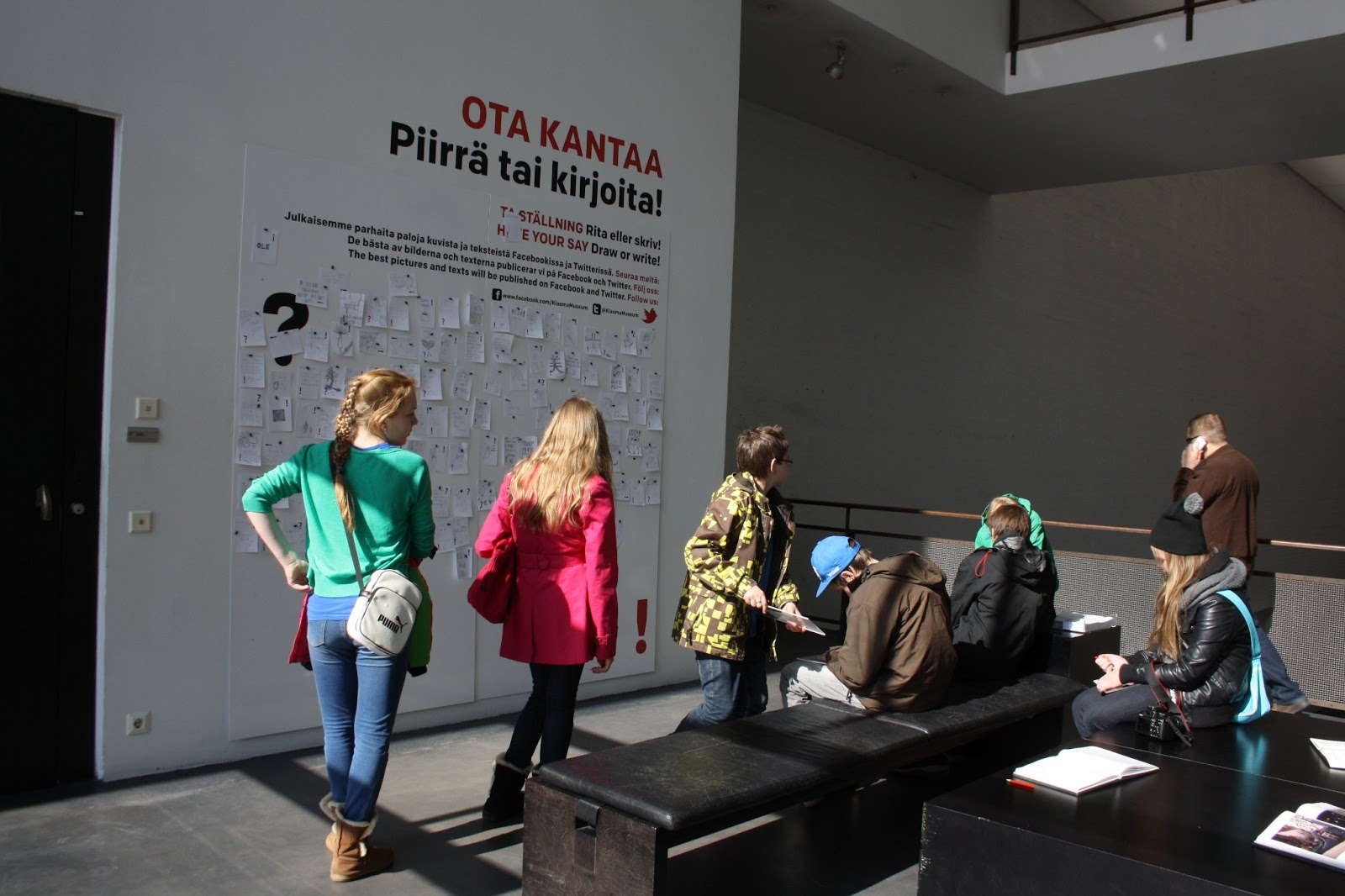
Kiasma - museum of contemporary art
Kiasma is a contemporary art museum located in Mannerheim street in Helsinki. Kiasma has five public floors, connected by ramps, stairs and lifts. Art Kiasma's collection has over 8000 works of art, both Finnish and foreign.
.jpg) 9 . St.Mary of the Admiral (or “The Martorana”). This church was founded in 1143. The linearity of the Norman original is unfortunately concealed behind the Baroque façade. Mass is celebrated according to the Greek Orthodox dogma in this church.
9 . St.Mary of the Admiral (or “The Martorana”). This church was founded in 1143. The linearity of the Norman original is unfortunately concealed behind the Baroque façade. Mass is celebrated according to the Greek Orthodox dogma in this church.


.jpg)